Light Control Lamp Design / 2025
ShyBloom.
A little light.
A living gesture.
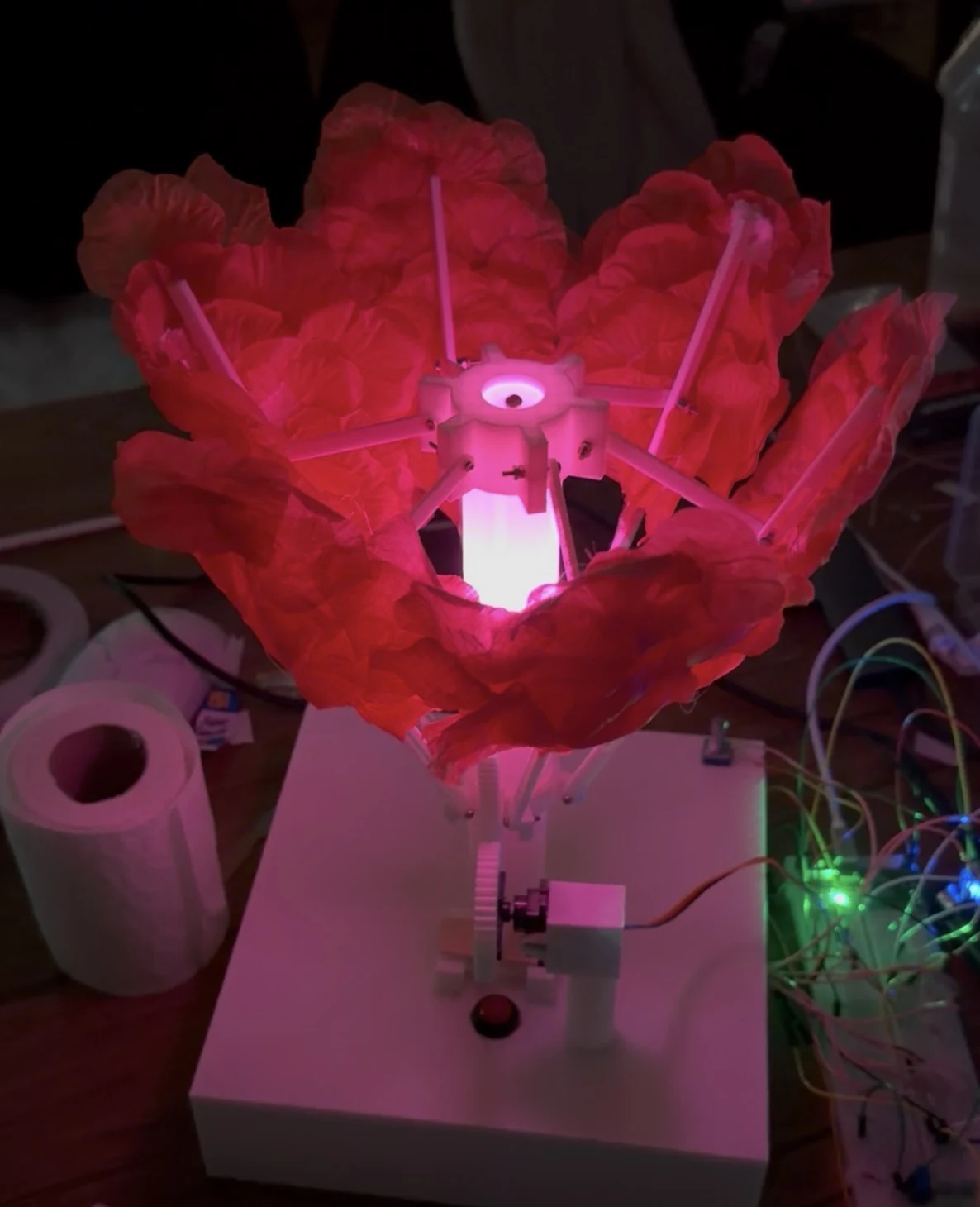
A flower lantern that responds to the light around it—opening, glowing and quietly breathing through a simple physical interaction.
Group 40 · Cici Song & Yuxuan Zhou
DE2 Gizmo / Physical Computing
a movement.
01 / A responsive object
Borrow a gesture
from nature.
What if a lamp felt
a little more alive?
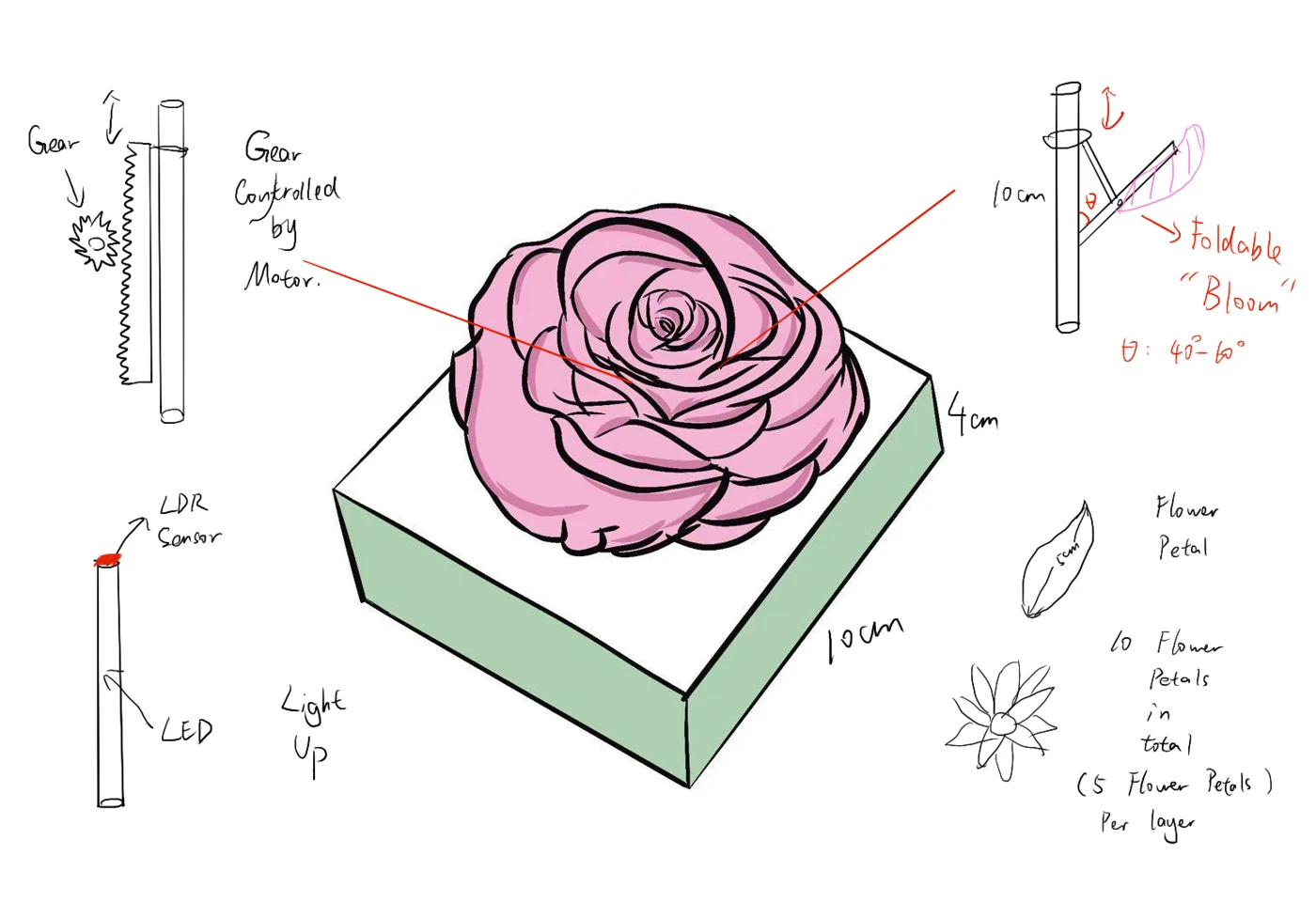
Inspired by the responsive movement of mimosa, ShyBloom pairs a flower-like form with an umbrella mechanism. Its changing silhouette is part of the interaction, alongside the light it produces.
The concept links a hand’s shadow and a darkened room through the same input: less light reaching the sensor at the top of the flower.
An expressive response.
02 / Light, translated into behaviour
Change the light.
See the response.
Lower the light reaching the LDR to open the flower. Adjust the glow with the brightness control, then try the button-controlled breathing mode.
Try the interaction
Relative input, not a lux measurement.
Shade the sensor to activate the light controls.
Reduced motion is enabled: the glow stays steady.
Illustration of the behaviour described in the portfolio. The hand interaction relies on shading the LDR; the system does not measure hand distance.
03 / The mechanism beneath the petals
An umbrella,
turned into a flower.
A rack-and-pinion lifts the lower ring along a fixed central pillar. Linked supports turn that translation into coordinated petal movement, driven by one servo at the base.
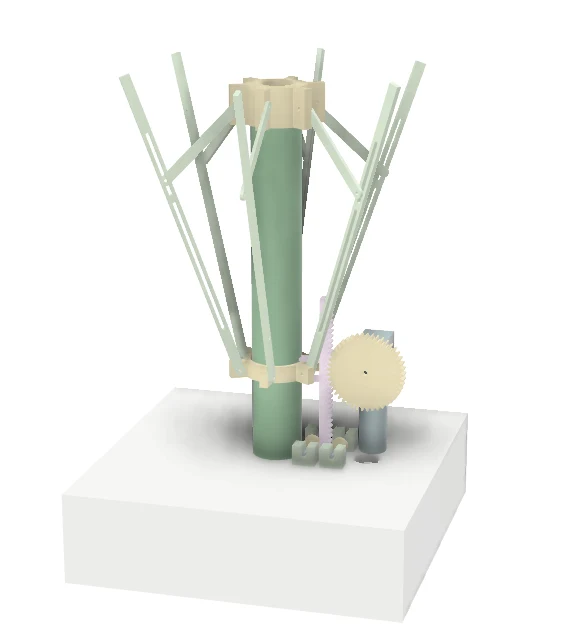
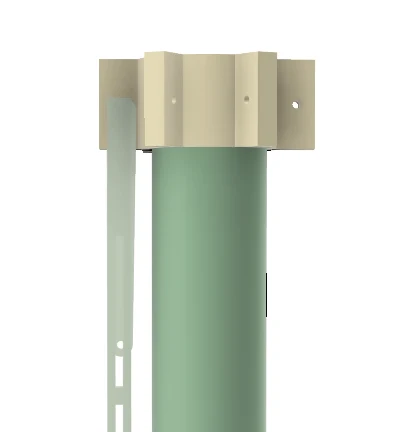
The upper ring anchors the motion.
The central pillar supports the stationary ring and houses five LEDs. The LDR sits at the top, where a hand can cast a shadow over it.
The lower ring coordinates the arms.
Its vertical travel changes the linkage geometry. Guiding that travel is as important as driving it.
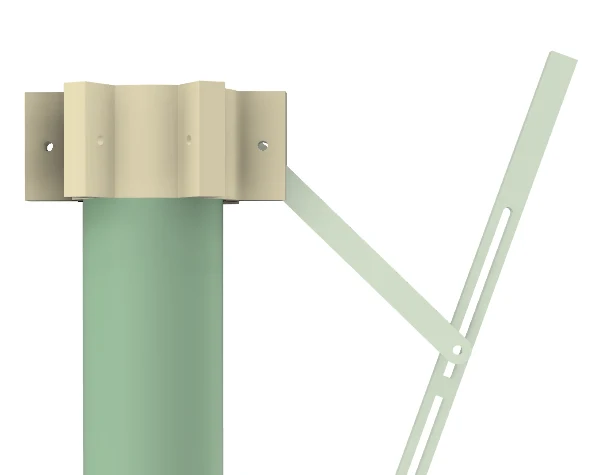
Rotate
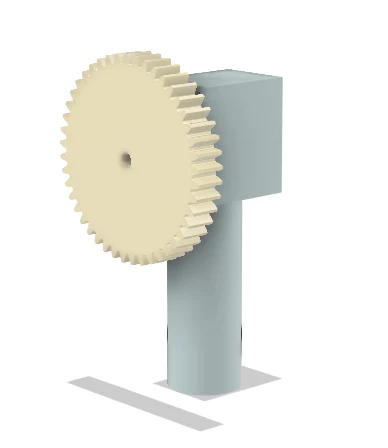
Servo + pinion
One servo turns the pinion at the base, giving the flower a single mechanical input.
Translate
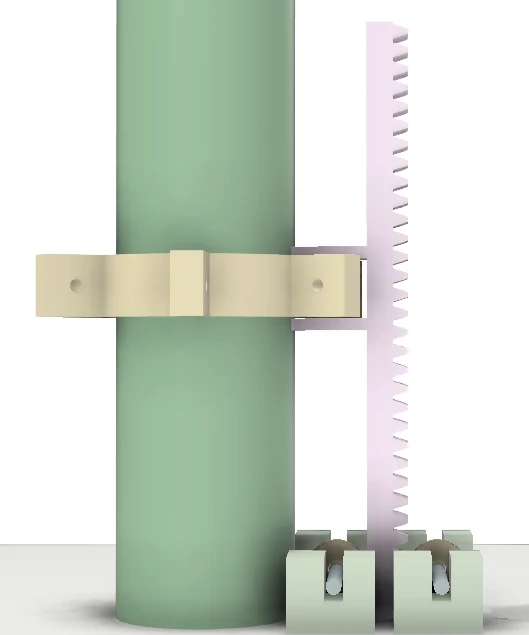
Rack + moving ring
The rack converts rotation into vertical movement of the lower ring around the central pillar.
Unfold
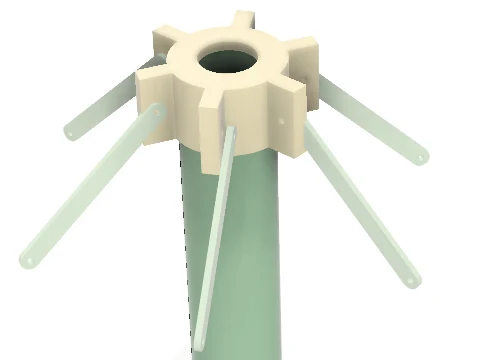
Linked petal supports
The upper ring anchors the arms. Movement of the lower ring changes their angle together.
Sensing & control
A small system,
with room for expression.
Bela connects the light sensor, potentiometer and button to the servo and LEDs. The supplied application uses Arduino-style C++ through Bela’s Arduino integration.
A threshold makes the decision.
The supplied code compares the LDR reading to a fixed threshold. The proposal’s adaptive ambient baseline was an earlier idea, rather than a feature of this snapshot.
Brightness changes the mood.
The potentiometer sets the light level. Breathing mode ramps brightness up and down within that selected level.
Small steps soften the motion.
The servo command is divided into incremental steps with short delays, making the opening and closing appear more gradual.
View the electronics sheet & source notes
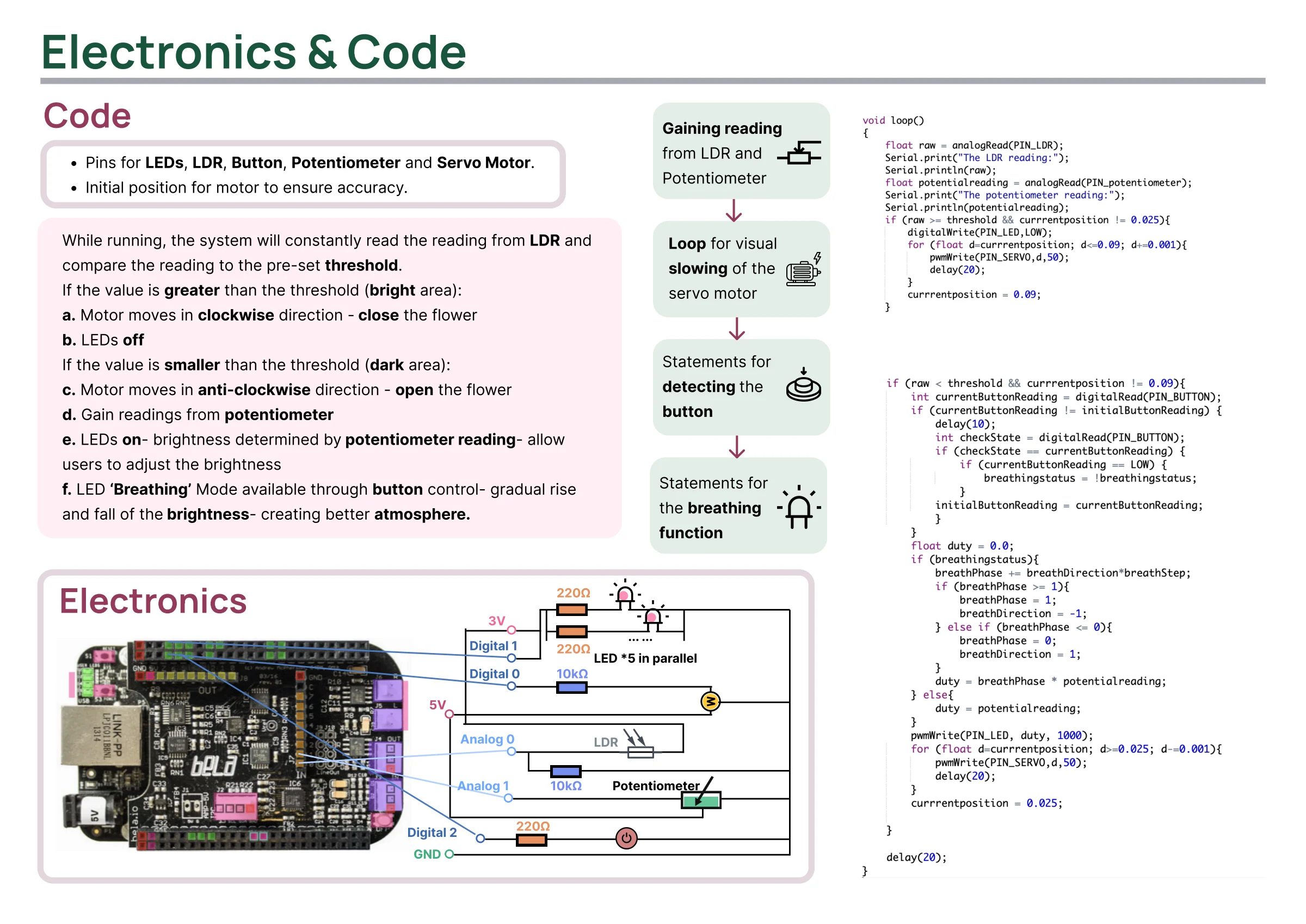
The portfolio describes the intended response. The archived code has inconsistent position guards that need review before hardware reuse, and its potentiometer pin differs from the drawing. The interactive sketch above illustrates the documented behaviour and is not a firmware emulator.
Download the original source snapshot04 / From CAD to a physical response
Watch the flower
come to life.
The team’s one-minute film shows the illuminated prototype, physical controls, CAD and workshop assembly. The exposed mechanism makes the relationship between movement and light visible.
Video overview: the assembled flower is shown in ambient light and illuminated in darkness, followed by interaction with the physical controls, CAD views, component assembly and the electronics setup.
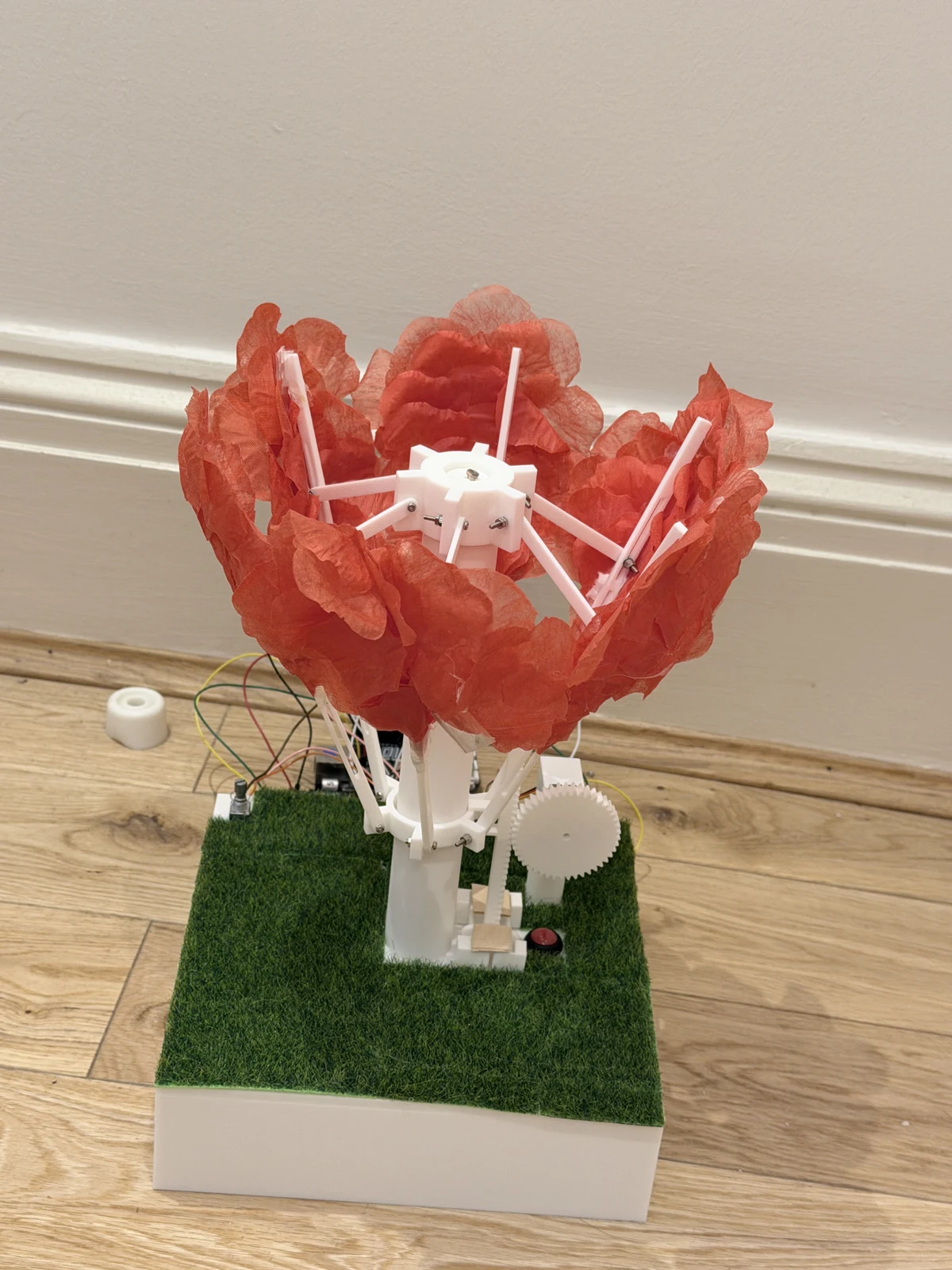
The work between the renders
A softer gesture needs
a steadier mechanism.
The main fabrication challenges came from unwanted movement: loose joints, excessive slot travel and a rack that drifted out of alignment. Small mechanical changes made the motion more consistent.
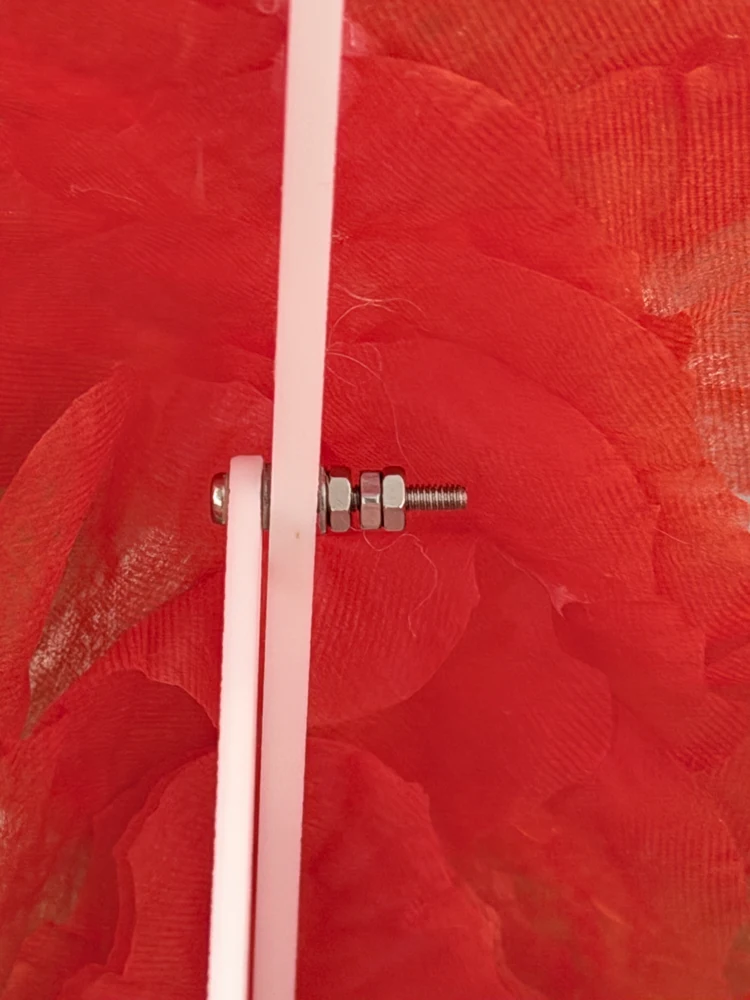
Steady the joints.
Loose beams moved sideways.
Washers on both sides and a fixing nut plus a locknut reduced play at the connections.
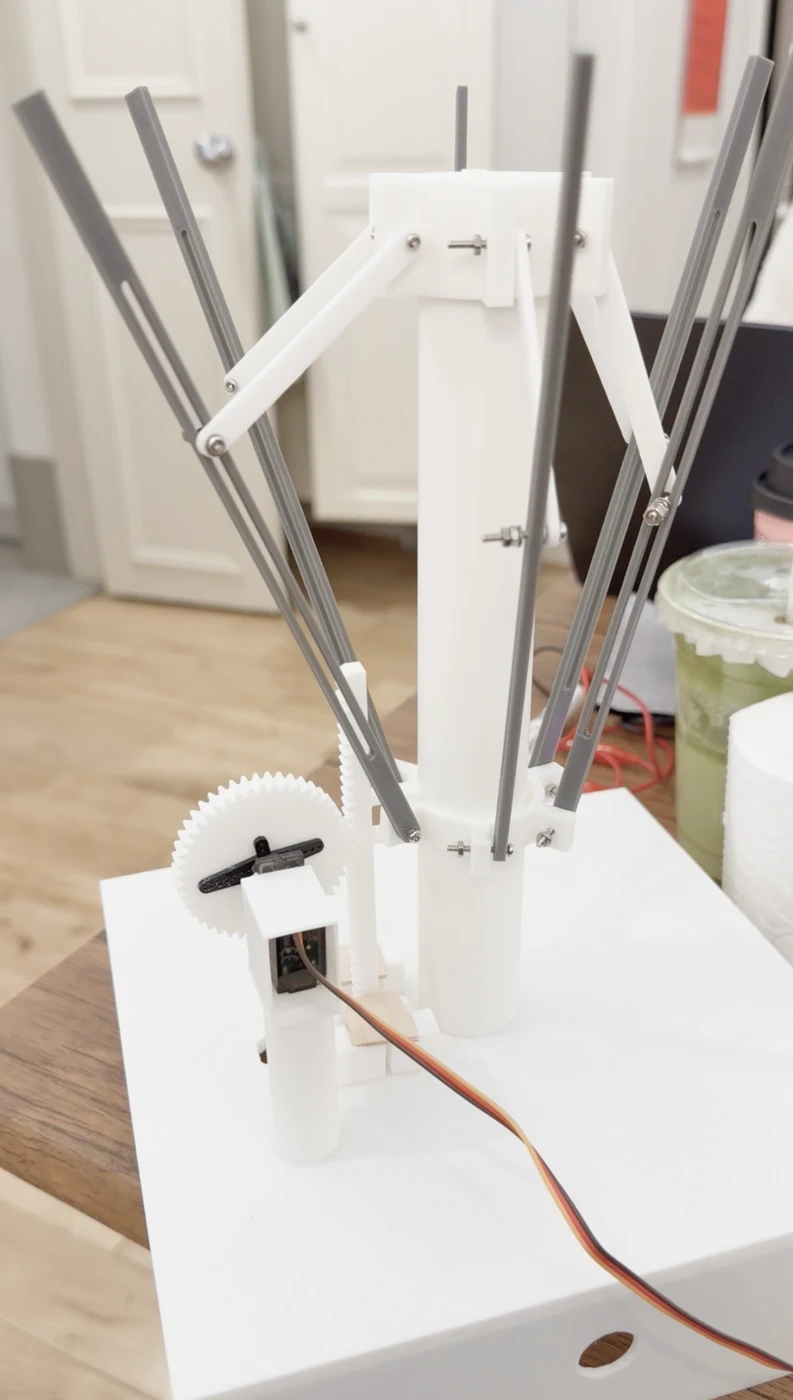
Constrain the travel.
Overlong beam slots allowed unwanted movement.
Shortening the slotted portion constrained the shorter link more consistently through the motion.
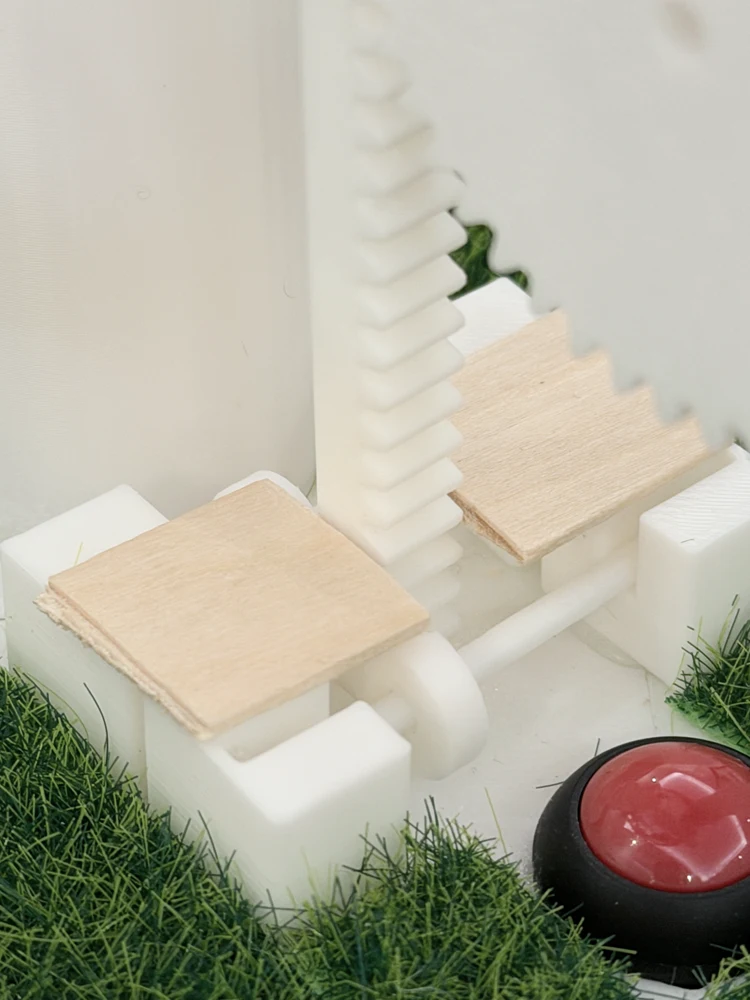
Guide the rack.
The rack shifted forwards and backwards.
Front and rear round supports, plus wooden side guides, stabilised its vertical path.
Reported challenges and improvements / Portfolio p. 5. These are prototype observations, without quantified endurance or repeatability testing.
05 / Outcome & next steps
More than switching
a light on.
ShyBloom connects sensing, illumination and mechanical movement in one expressive object. The project’s value lies in that integration: a small change in the environment becomes a visible physical gesture.
A tangible interaction.
A fabricated flower-lantern prototype, a linked opening mechanism, integrated lighting and controls, a demonstration film and a five-page design portfolio.
Refine the light and motion.
The portfolio proposes RGB or NeoPixel lighting and placing light sources on the petals. More consistent guidance and further cycle testing would support a more durable mechanism.
A two-person project
Cici Song & Yuxuan Zhou
Group 40 / DE2 Gizmo / Physical Computing. Concept development, CAD, electronics and fabrication are presented here as shared project work.